Archmage Idle
- 4.7
- Rating
- 50.00K
- Installs
- Free
- Price

 Analysis by App-foxy
I found Archmage Idle most interesting as a game that fits around real life rather than demanding all of my attention. It is a free simulation game from TopCog, built around the idea of running a wizard guild as its archmage. The central appeal is incremental progress: I can make decisions, check results, improve the guild, and step away without feeling that every minute away from the screen ruins the session.
That makes it easy to imagine on a shared household device. One person can open it for a short check while waiting for dinner, another can try a few decisions later, and the game still feels suited to brief visits rather than a long uninterrupted sitting. I would not treat it as a multiplayer activity, though. Its value in a household comes from its flexible pace, not from everyone managing one guild together at the same time.
After spending time with it, my view is fairly clear: this is a good choice for players who enjoy watching a system grow and making small, meaningful adjustments. It is less suitable for anyone looking for a fast action game, a story-heavy role-playing adventure, or a title where every session delivers a dramatic event. The quiet rhythm is the point, but that same rhythm will feel too slow if you need constant excitement.
You May Also Like

 AccuWeather: Weather Radar
AccuWeather Review: A Quick, Clear Forecast for Everyday Decisions
For everyday plans, the best forecast is the one you can understand quickly. AccuWeather makes rain timing, radar, and local conditions easy to act on, with a few trade-offs.

 Hill Climb Racing
Why Hill Climb Racing Still Turns Crashes Into One More Run
A tiny car, a bumpy hill and one more upgrade: Hill Climb Racing keeps resurfacing because its simple chaos makes every near-miss feel personal.

 AliExpress - Shopping App
AliExpress Makes Global Shopping Feel Personal, but Shoppers Bear the Risk
AliExpress turns a global marketplace into a pocket-sized discovery engine. Its reach is useful, its shopping loop compelling, and its trade-offs easy to miss.

 Lords Mobile: Kingdom Wars
Lords Mobile Is a Kingdom-Building Routine, Not a Quick Match
A case-by-case verdict on the building, battles, device demands, and social commitments that make Lords Mobile rewarding for some players and exhausting for others.

 PDF Scanner app - TapScanner
TapScanner Makes Paperwork Easier to Capture, Check, and Share
TapScanner makes scanning with a phone feel less like a rescue operation and more like a dependable step in getting work done. Its capture tools are useful, though not flawless.

 Block Blast!
 Shows How Much a Puzzle Game Can Leave Out
A quiet grid game shows why puzzle players increasingly value instant clarity, repeatable skill and low-pressure play—and where the genre still needs to catch up.
More From Our News Desk
View All News


How the guild works in everyday play
I approach the guild as a small management routine: check what has accumulated, choose an improvement with a purpose, then leave it alone long enough to see whether that choice helps. That rhythm works best when I decide in advance what I want the next visit to answer, rather than tapping through every available option. From there, it’s worth looking at how those brief decisions fit into an ordinary day.
A simulation built around returning at the right moments
The archmage role gives the game a useful frame. Instead of simply controlling one hero, I am encouraged to think about the wider condition of a wizard guild. That changes the feeling of progress. I am not only asking whether a character is strong enough; I am considering whether the overall operation is moving in the right direction and whether an upgrade is worth prioritizing now or later.
Idle and incremental games can become confusing when they throw too many currencies, screens, and upgrade paths at the player. Archmage Idle works best when I approach it as a sequence of small management decisions. I check what has accumulated, decide where the next improvement should go, and leave the game to continue its cycle. The satisfaction comes from seeing modest choices add up over repeated visits.
That structure is especially convenient on a phone or tablet that several people use during the day. A quick visit does not require the same commitment as a conventional role-playing game. I can play while taking a short break, then put the device down without needing to remember a complicated combat sequence or reach a checkpoint.
There is a trade-off here. The game’s progress can feel rewarding when I am in the mood for a calm routine, but less impressive when I want direct control and immediate feedback. An action RPG gives me a clear sense of movement and reaction. A traditional management game may offer deeper planning across a larger map or economy. This title sits between those expectations: it uses RPG language and fantasy presentation, but its main pleasure is incremental administration.
What I would do during a normal day
My preferred routine is to open the game at the start of a break, review what the guild has produced, and spend only after deciding what kind of progress I want next. That last part matters. Spending every available resource immediately can make the game feel like a sequence of automatic taps. Waiting briefly and choosing an upgrade with a purpose gives the system more texture.
For example, I might check in before work, make one improvement, and close the game. Later, I can see whether that decision changed the pace of progress enough to justify continuing in the same direction. In the evening, I have a clearer idea of whether I should keep investing in the current path or save for a more expensive improvement. This turns short sessions into a simple planning loop instead of a repetitive collection task.
A useful habit is to separate “I can afford this” from “this is the best use of my resources.” Incremental games often tempt me with immediate purchases, but the strongest long-term result usually comes from recognizing what is currently slowing the guild down. I found that this small pause before upgrading made the experience more engaging and reduced the sense that I was only following glowing prompts.
Another practical tip is to avoid opening the game with the expectation of a full role-playing session. The design is better suited to several small visits than one extended sitting. If I keep tapping after the meaningful decisions are finished, the experience becomes less satisfying. The game rewards a stop-and-return habit, which is convenient but may frustrate players who want a substantial session every time they launch a title.
Shared devices need clear boundaries
On a shared tablet or family phone, I would establish one simple rule before anyone begins: decide whose game space is being used and do not make changes casually. A guild-management game can make progress feel personal even when the device belongs to everyone. One person might save resources for a particular improvement while another spends them immediately, and both actions can seem reasonable from different perspectives.
I would also avoid handing the device to a younger player while the game is open to the active guild unless I am comfortable with accidental changes. The game is rated Everyone, which makes it approachable from an age standpoint, but an age rating is not the same thing as protection from unwanted taps or purchases. The practical boundary is household supervision and a clear understanding of who is currently playing.
This is one of the less obvious considerations with an idle game. Because the pace feels relaxed, it is easy to assume that a child or guest can simply explore without consequences. In reality, exploration inside a progressing management game can alter the direction of the guild. I would use a separate device profile or account boundary where the operating system supports one, rather than treating a shared save as a communal toy.
I would be particularly careful around the purchase layer. The game is free to download and includes optional purchases priced from $0.99 to $19.99 per item. That does not make spending unavoidable, but it does mean a shared device deserves the same purchase safeguards I would use for any free-to-play title. An adult should handle payment settings, and children should know that “free” refers to access, not necessarily to every optional item inside the game.
Coordination without pretending it is a group game
Archmage Idle can work in a household when people coordinate informally, but I would not describe that as cooperative play. There is no reason to assume that two people can build the same guild together in a structured way, so the safest approach is to treat each save as belonging to one player. Others can watch, comment, or discuss choices, but the person responsible for the save should make the final decisions.
That arrangement can actually make the game a pleasant conversation starter. One player may prefer steady improvements, while another may be more willing to save for a larger goal. Discussing those choices gives the simulation a little more depth without requiring everyone to be online at once. I enjoy that kind of low-pressure comparison, provided nobody edits another person’s progress without permission.
If several household members want to play, I would recommend agreeing on a simple schedule for a shared device. The idle structure means turns do not need to be long. One person can check the guild in the morning, another after school or work, and another in the evening. The important point is to leave notes verbally or mentally about what was changed, rather than letting several people make unrelated decisions in quick succession.
This also answers a common concern about whether the game is suitable for short attention spans. It is easy to pause, but that does not mean every player will enjoy waiting. A child who expects immediate rewards may lose interest, while someone who likes checking gradual progress may return willingly. I would introduce it as a calm management game, not as an action adventure, so expectations are set correctly from the beginning.
Age, trust, and the role of an adult
The Everyone rating makes the game broadly accessible, and the fantasy setting is much easier to place in a family environment than a title built around mature themes. Still, I would judge suitability by the child’s habits as much as by the rating. The key questions are whether the player understands that progress takes time, can accept not buying every tempting option, and can respect another person’s save.
For younger players, I would sit with them during the first session and explain the difference between collecting, upgrading, and purchasing. That first conversation is more valuable than simply handing over the device. It gives the child a way to ask what a button does before pressing it and makes the household rule about spending clear.
I also think trust matters more here than technical complexity. An idle game can look harmless because it does not require rapid reactions, but it still contains decisions that affect progression. If the device is shared, I would not rely on a child remembering which changes are reversible. The person who owns the save should remain nearby until everyone understands how the game is being used.
For adults, the title can be a comfortable wind-down game. I can check it without entering a demanding competitive environment, and the guild theme gives the routine more personality than a plain number-increasing app. However, adults who dislike waiting, repeated collection, or optional purchase prompts may find that the fantasy wrapper does not change the underlying incremental structure enough.
Version, access, and who should install it
The current version is 2.0.6, and the game requires Android 7.0 or later. That makes the operating-system requirement fairly approachable for many older Android devices, although the actual experience will still depend on the phone or tablet’s general condition. On a shared household device, I would make sure there is enough room for normal app updates and that the device is not already struggling with background activity.
TopCog has positioned the game as a free experience, and it has passed the early-discovery stage with over 50 thousand installs. Its average rating is 4.6 from around 1.3 thousand ratings, with roughly 122 written reviews. I read those figures as a useful sign of interest rather than a guarantee that every player will enjoy the same pace. Incremental games tend to divide people by temperament: patience feels like a reward to one player and a delay to another.
The most natural audience is someone who likes simulation games but wants a lighter commitment than a large city builder or a detailed strategy title. It can also suit a role-playing fan who enjoys the idea of progression but does not always have time for battles and exploration. I would skip it if my main goal were a rich narrative, precise tactical combat, or a game that feels equally exciting during every minute of play.
Where it differs from familiar alternatives
Compared with a standard idle clicker, the wizard-guild setting gives my decisions a clearer identity. I am not just watching abstract figures rise; I am thinking in terms of an archmage’s responsibilities and the direction of a magical organization. That theme helps the waiting feel purposeful, even though the underlying appeal remains gradual accumulation.
Compared with a conventional role-playing game, the cost is direct control. I do not get the same immediate satisfaction as moving through a dungeon, reacting to enemies, or choosing dialogue in a story. In exchange, I get a game that asks less of me physically and fits more easily into a busy day. The better option depends entirely on whether I value involvement or convenience at that moment.
Compared with a full management simulator, this is the more approachable choice. I can engage with the fantasy premise without learning a large set of interconnected systems before seeing progress. The downside is that players who want detailed economic chains, extensive customization, or a world that constantly changes may eventually find the structure too narrow.
One of my strongest recommendations is to use it as a companion game rather than the only game on a device. It works well between larger activities, during a commute, or as a low-pressure evening check-in. It is less convincing as the main source of entertainment for someone who wants a long, absorbing session with a beginning, middle, and end each time they play.
The friction I noticed while deciding whether to keep playing
The biggest limitation is the possibility of routine overtaking decision-making. Once I understand the basic loop, some visits can feel like maintenance rather than discovery. That is not necessarily a design flaw; it is the natural risk of incremental games. Still, I would watch my own habits and stop when I am checking out of obligation rather than enjoyment.
The optional purchase range also affects how I evaluate the game in a household. Free access is helpful, especially when several people want to try it, but purchase prompts require attention. I would not let a child use a payment-enabled profile unsupervised, and I would not assume that a relaxed pace eliminates the need to review spending choices.
Another trade-off is that the game’s best moments depend on patience. If I want a clear payoff immediately, the guild-management format can feel restrained. If I enjoy returning later to see how a previous choice worked out, the same restraint becomes the reason to continue. I found it more rewarding when I treated progress as a series of experiments rather than a race toward an endpoint.
The game also asks for a certain amount of personal organization on a shared device. Without clear account boundaries, household use can become confusing quickly. That is not a criticism of the fantasy concept itself, but it is an important practical issue for anyone planning to let several people play on one phone or tablet.
My household verdict
I would recommend Archmage Idle to a friend who wants a gentle simulation game with role-playing flavor and a progress loop that respects short sessions. It is particularly well suited to adults who like checking systems, making small improvements, and returning later to see the result. It can also fit a family device when one player owns the save, purchase settings are handled responsibly, and everyone understands that it is not a shared multiplayer experience.
I would not recommend it to someone who needs constant action or a strong narrative payoff. A traditional RPG, an active strategy game, or a more detailed management simulator would be a better match in those cases. The same applies to households where several people are likely to change the same save without coordinating; the relaxed presentation does not remove the risk of frustrating one another.
My final impression is positive because the game knows what kind of time it wants from me. It does not try to turn every visit into an event. Instead, it gives me a magical guild to check, improve, and gradually understand. The smartest way to play is to set clear boundaries, spend with a plan, and let the incremental pace remain a convenience rather than a chore. With that mindset, this free simulation game from TopCog is an easy one to keep nearby for quiet moments.
FAQs for Archmage Idle
01What is Archmage Idle, and how does its gameplay work?
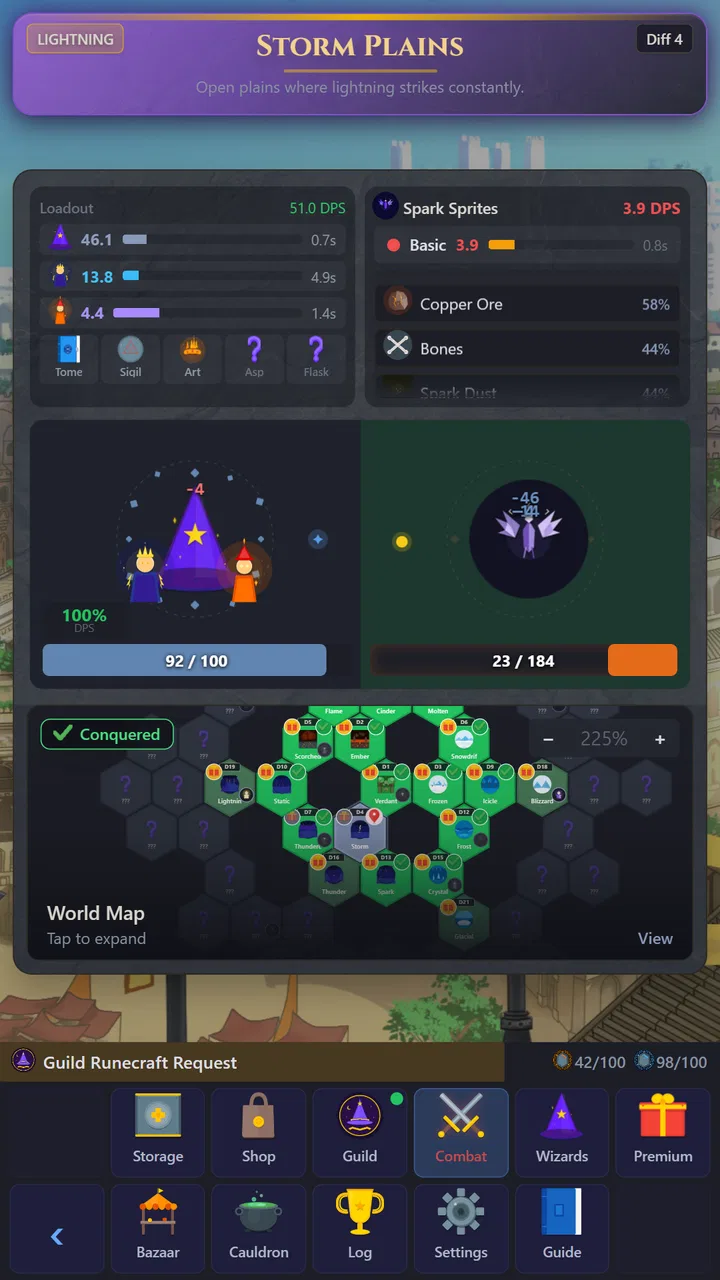
Archmage Idle is an idle role-playing game centered on developing a powerful mage through automated battles, character upgrades, equipment, skills, and progression systems. Your hero continues earning rewards while you are away, but active play is still useful for claiming bonuses, improving abilities, completing stages, and adjusting your build. The experience is designed for players who enjoy gradual growth rather than constant manual combat.
02Can Archmage Idle be played without spending money?
Yes, Archmage Idle can generally be played without making purchases. Free players can progress by collecting idle rewards, completing missions, participating in events, and using the available upgrade systems. However, optional purchases may provide extra resources, faster progression, or premium rewards. Players who prefer not to spend should expect a slower pace and may need to manage resources carefully, especially when upgrading multiple aspects of the mage at once.
03Does Archmage Idle require an internet connection?
An internet connection is usually important for Archmage Idle because idle rewards, account progress, events, advertisements, and server-based features may need to synchronize with the game. Some portions of gameplay may appear to work temporarily offline, but uninterrupted access cannot be guaranteed. Connecting regularly is recommended so your progress is saved correctly and you can collect rewards or participate in limited-time activities.
04Is Archmage Idle suitable for beginners who are unfamiliar with idle RPGs?
Archmage Idle is approachable for newcomers because the basic loop is easy to understand: fight enemies, collect resources, strengthen the mage, and unlock more content. The game gradually introduces equipment, abilities, and other systems. Still, the number of upgrade options can become more complicated later. Beginners should avoid spending every resource immediately and focus on a balanced build before investing heavily in specialized upgrades.
05What should I know about advertisements, purchases, and progression before downloading?
Archmage Idle may include optional advertisements and in-app purchases, depending on the version and platform. Ads can sometimes be connected to bonus rewards, while purchases may offer currency, packages, or convenience features. Progression is built around repeated battles and incremental upgrades, so it may feel slow if you expect rapid advancement. Check the store listing for current pricing, age guidance, and device requirements before installing.
Pros
- Simple idle progression makes it easy to play in short sessions.
- Automatic battles let you advance even when you are away.
- Many heroes and spells offer room for different team combinations.
- Offline rewards help maintain progress without constant internet access.
- Stylized fantasy visuals and effects make battles easy to follow.
Cons
- Progress can become heavily dependent on repeated upgrades and waiting.
- Random summons may make building a strong team feel unpredictable.
- Later stages can encourage frequent grinding for resources.
- The interface may feel crowded for players who prefer simpler menus.
- Some features and rewards may be tied to ads or in-app purchases.

Archmage Idle
Gallery